- Home
- Knitting Swatch Record Sheet
Knitting Swatch Record Sheet (Free Printable)
By Janice Jones, Last Updated May 28, 2026
Have you ever discovered a stitch pattern you loved and decided to knit a quick swatch before starting a project? If so, what happened to that swatch afterward? When I first learned to knit, I created plenty of swatches, then threw them into a box, knowing that I would use that stitch pattern at some point, but not ready to start a new project. Then I cleaned out, and they went into the dumpster.
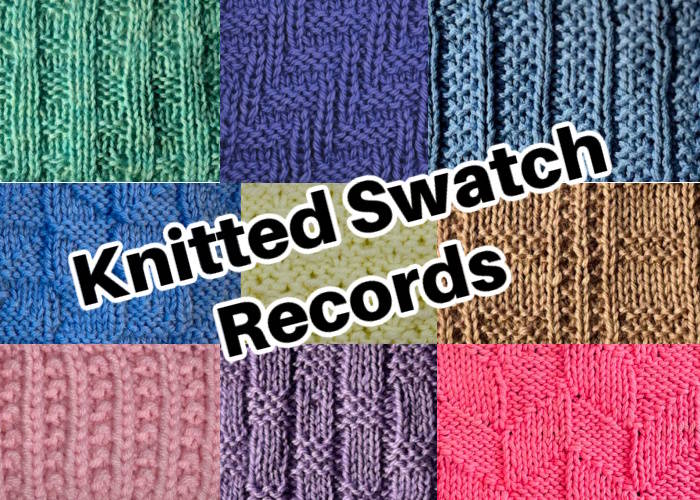
At first, many knitters treat swatches like temporary scraps of fabric. But over time, those little samples can become valuable references that save time, improve gauge accuracy, and help you make better project decisions.
Some people keep their swatches in the hope of sewing them all together to make something like a bag or a blanket, and that is fantastic, but what if that type of project does not appeal to you? What do you do with all those swatches afterward?
Why Swatches Matter
Why do we even take time to knit a swatch? Most knitters swatch to check gauge before beginning a project, and for good reason. But there are other reasons for knitting a swatch:
- Practice your knitting techniques, such as tension
- Learn a new stitch pattern
- See how a new yarn will respond
- Observe how a specialty yarn looks as a fabric
- Determine which size needles to use with various yarn weights
I am sure there are other reasons, but all of these are valid reasons for knitting a swatch. But just as important is what you do with that swatch once you are finished? Do you throw it into a box and forget it, or take the time to weave in ends, block, calculate gauge, or record the details for later reference?
Even if you are making that swatch prior to starting a big project, you should take the time to learn as much as you can about the yarn and needle combination. Many people unravel the swatch because they believe they will need the yarn to finish the project, but I recommend keeping it. Why?
As knitters, we may think we have amazing memories, but after swatching, we are not going to remember the information that we most likely need for future reference. Keeping records will save time and a great deal of frustration.
How Big Should The Swatch Be?
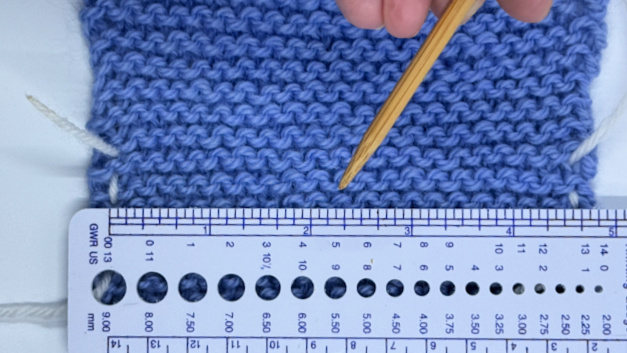
Gauge swatches are normally measured and calculated within a four-inch square (10 cm). Swatches should be larger than four inches, though, because you don’t want to measure the edge stitches or the cast-on or bind-off rows.
Always cast on the number of stitches indicated in the pattern. For example, if the stitch pattern calls for you to cast on a multiple of 7 + 2, you would cast on 7, 14, 21, or 28 and then add 2 stitches. To get a swatch larger than 4 inches, you will likely need to cast on 28 + 2 or 30 stitches.
If you are new to gauge calculations, I would recommend checking out my article on calculating gauge for knitters.
Why Keep a Record of Your Knitting Swatches?
If you are just getting started with knitting, swatches can show you just how much you improve over time, and that is a huge confidence boost. Recording swatch details can also save you a great deal of time in the future, especially if you take time to block and calculate the gauge.
Say that this is the first time you use a particular yarn, but you soon realize it will be your favorite and you will return to the brand time and time again. If you keep your written details about needle sizes and gauge, you may not have to reswatch when you decide to use the same yarn again.
Some projects will benefit from using different needle sizes. I always say to use the needle size recommended on the yarn label, and that is good advice, but you may not want to follow those guidelines for every stitch pattern you knit.
For example, if you are knitting lace, you may want to go up a needle size or two. The only way you will know that is to knit a couple of swatches. Keeping this information handy will be helpful if you decide to create another similar project.
What Information Should You Record?
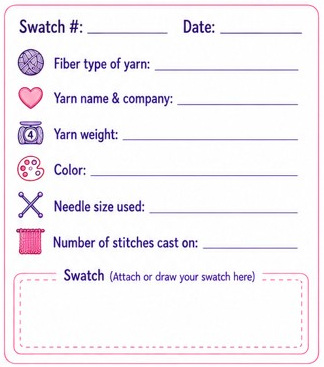
Some information may be more practical than other information, but a few vital pieces of info will be useful:
- Yarn name and manufacturer (Example: Red Heart® Super Saver® worsted weight yarn)
- Fiber content: 100% Acrylic
- Needle size: US size 8 (5.0 mm). You may also jot down the type of needles you used (wood, bamboo, steel, square)
- Number of cast-on stitches: 26 stitches
- Stitch Pattern: Stockinette Stitch
- Blocked gauge calculations: 17 sts - 23 rows = 4" (10 cm); indicate if swatch was not blocked
- Washing instructions: Machine washable, dryable
- Drape/stretch: More sturdy and less stretch than anticipated. Next time, try size 9 needles.
- Date knitted
- Anything else that you noticed about the yarn: The swatch does not lie flat
How to Use a Swatch Record Sheet
At the end of this article, you will be able to download a free record sheet. Print as many as you like. Each sheet has room for four swatches. Cut them up and pin them to your finished swatch. These are the steps to take.
- Knit the swatch (Check out my extensive list of knit stitches).
- Block it (Learn how to block knitted fabric)
- Weave in ends (alternately, some people prefer to weave in ends and then block)
- Measure and calculate the gauge
- Record details
- Attach the swatch with a rust-proof pin or piece of waste yarn
- Store in a place that is not exposed to direct sunlight. A covered box works well.
Free Knitting Swatch Record Sheet Printable
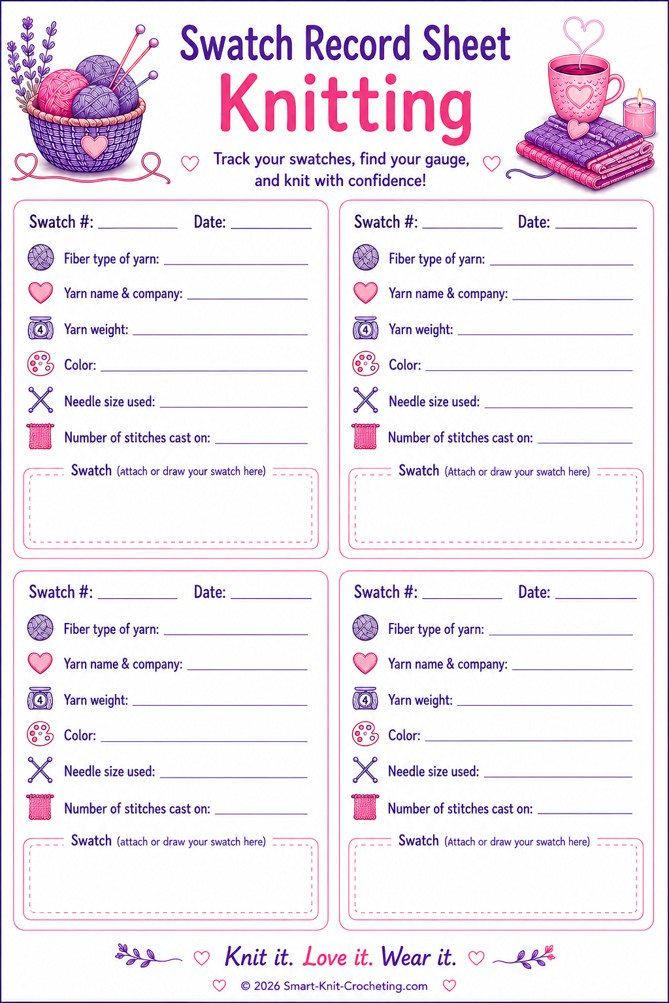

Click the button to download the printable swatch tag sheet. Cut the sheet apart and attach each record to the matching swatch.
Common Swatching Mistakes Beginners Make
There are some general mistakes that new knitters make when creating their swatches:
Measuring Before Blocking
Blocking allows the fibers to relax, so your blocked swatch will not be the same size as your unblocked swatches. Get into the habit of weaving in ends. You’ll be an expert after a few swatches.
Using the wrong needle size
It is always a good idea to check and follow the yarn label for the size needles to use. If you don’t get the gauge you need, reknit the swatch with a different size needle.
Swatching flat for circular projects
The gauge for flat versus circular knitting projects may be different. There is a way to swatch circular projects by using two double-point needles. It takes a little more yarn, and you won’t be able to unravel it and reuse the yarn, but it is worth it in the end.
Not washing the swatch correctly
Many yarns change after washing. A swatch that looks perfect before blocking may stretch, shrink, soften, or bloom afterward.
Throwing Swatches away
Throwing swatches away or unraveling and reusing the yarn is not a good practice in my opinion. Each swatch tells a story. (Examples)
- I love this pattern and can’t wait to use it, or I’ll never try to knit this again.
- My knitting tension is improving
- It is difficult to get both row and stitch gauge for this pattern
- I love this yarn-and-needle combination, or I hate this needle-and-yarn combo.
Should You Keep Old Swatches?
If I haven’t convinced you yet, I hope you will keep your old swatches unless, of course, you live in a tiny home and storage is at a premium.
Establish Swatch Libraries for Future Projects
You may find that you fall in love with a specific needle, yarn, and stitch pattern, but don’t want to start a new project at this time.
Attach Labels
Use twine or scrap yarn to tie the label to the swatch, or use rust-proof pins or safety pins.
Storing Samples
Store in a cool, dry area in a covered box or bin, or start a swatch notebook.
Learning from old projects
Examining old swatches is like looking at old scrapbooks. Your swatches may be all that remains of projects made years ago – that scarf you made for Uncle Bob, the market bag for your sister, or a phone case you created as an end-of-school gift for your child’s teacher.
Conclusion
These free printable Swatch tags are my gift to you for visiting my website. Download them and print as many copies as you like. These printables are free for personal use but may not be reproduced for resale.
Consider creating a swatch notebook. A 2 or 3-inch 3-ring binder works well with plastic page protectors. Keep it with your other knitting books, and you have your very own stitch library that is better than any hardbound or softcover stitch guide.
Always know that we continue to learn and perfect our craft. Perfection does not come overnight. I can say I learned best from my mistakes, and one of the biggest was not saving my swatches. I do now, though, and I have several stitch notebooks to show for it.
Disclosure:
This post contains affiliate links. If you buy through them, I may earn a small commission at no extra cost to you.
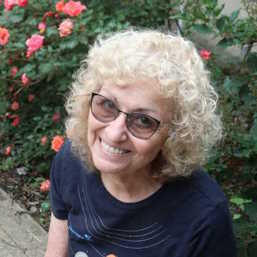
Janice Jones is a Certified Knitting and Crochet Instructor who creates beginner-friendly patterns and tutorials, backed by a 389-page library of practical knitting and crochet content.
Most Popular Pages
Comprehensive Guide to Yarn

All Types of Crochet Stitches
36 Reversible Knit Stitch Glossary
How to Crochet the Second Row
Dog Sweater Patterns
Working with Alpaca Yarn
Free eBooks, Just for You
Get my beginner eBook guides to Knitting and Crocheting, just for signing up for my monthly newsletter.
Choose one or both when you sign up.
About the Author: Please allow me to introduce myself
Janice Jones is a Certified Knitting Instructor and Certified Crochet Instructor through the Craft Yarn Council who focuses on beginner-friendly patterns, stitch guides, and technique tutorials. She has built a library of 389 pages on her website, sharing practical instructions and patterns, and has completed projects ranging from crochet blankets to knit sweaters. You can explore her work on her website. She makes items for Warm Up America and often knits and crochets sweaters for her small dogs.
Thank you for visiting Smart-Knit-Crocheting. I hope this and all of my tutorials will give you the inspiration to continue your knit or crochet journey. For a complete list of all the pages on my site, please visit my table of contents.
I participant in the Amazon Services LLC Associates Program, an affiliate advertising program designed to provide a means for sites to earn advertising fees by advertising and linking to Amazon.com. “As an Amazon Associate I earn from qualifying purchases.” These earnings go towards supporting my website.
Home | Contact | About | Privacy Policy | Disclaimer
I DO NOT SELL ANY PERSONAL INFORMATION FROM THIS WEBSITE. PLEASE SEE MY PRIVACY POLICY FOR MORE DETAILS.
Copyright © 2006-2026 Smart Knit Crocheting. All Rights Reserved
Please Share
Remember, Sharing is Caring