- Home
- Irish Crochet
Irish Crochet Explained: Traditional Lace Technique for Modern Design
Rewritten by Janice Jones |Updated December 2025
Irish crochet is a traditional lace-making technique dating back to the mid-19th century, known for its raised motifs, delicate mesh backgrounds, and highly decorative appearance. While it is often associated with antique lace collars and heirloom garments, Irish crochet remains highly relevant today and continues to inspire modern designers and fiber artists.
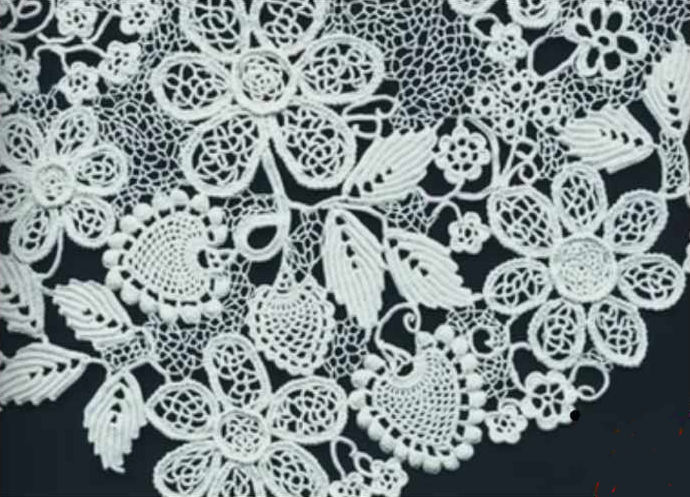
Unlike other types of crochet lace, which are worked as a single fabric, Irish crochet is created by crocheting individual motifs first, then joining them together with a mesh or fine connecting stitches. This modular approach offers incredible design flexibility, enabling the technique to be adapted for both intricate lacework and more wearable, contemporary garments.
This page is not intended as a complete step-by-step tutorial. Instead, it serves as an overview of Irish crochet, how it works, and how the technique has evolved from its historical roots into modern crochet design.
Irish Crochet: A Traditional Technique with Modern Applications
Irish crochet developed during a time when fine lace was highly valued, and many of its defining features—three-dimensional motifs, floral elements, and open mesh backgrounds—remain central to the technique today. What has changed is how those elements are used.
Modern interpretations of Irish crochet often focus on wearability rather than strict historical accuracy. Contemporary designers may simplify motifs, adjust scale, or combine different fibers and colors to create garments that are lighter, more flexible, and better suited for everyday use.
Rather than viewing Irish crochet as an intimidating or outdated method, many crocheters now approach it as a creative system: build motifs individually, experiment with layout, and connect them in ways that suit the project. This makes the technique adaptable for everything from statement garments to decorative accents.
Modern Inspiration in Irish Crochet
Some contemporary designers have explored ways to reinterpret Irish crochet for modern clothing, blending traditional motif-based construction with updated silhouettes, fiber choices, and color palettes. These approaches show how the technique can move beyond purely decorative lace and become part of functional, wearable design.
By adjusting motif size, spacing, and yarn selection, Irish crochet can be adapted for both warm garments made with wool and lightweight summer pieces worked in cotton or linen. This flexibility is one of the reasons the technique continues to appeal to experienced crocheters today.
Below are examples of classic Irish crochet motifs. These simple, repeatable shapes form the foundation of Irish crochet design and demonstrate how individual elements can be combined into a cohesive fabric using mesh or fine joining stitches.
Irish Crochet Motifs




More information on Irish Motifs can be found on this site.
Irish Crochet FAQ
What is Irish crochet?
What is Irish crochet?
Irish crochet is a lace technique where individual motifs, such as flowers or leaves, are crocheted separately and then joined together using a fine mesh or connecting stitches to form a fabric.
Is Irish crochet difficult to learn?
Is Irish crochet difficult to learn?
Irish crochet is considered an advanced technique, but it does not require complex stitches. The challenge lies in planning motif placement and joining them evenly, not in the stitches themselves.
How is Irish crochet different from regular crochet?
How is Irish crochet different from regular crochet?
Unlike regular crochet, which is usually worked row by row, Irish crochet is built from separate motifs that are assembled later. This allows for more flexibility in shaping and design.
Is Irish crochet still used today?
Is Irish crochet still used today?
Yes. While it originated as a traditional lace method, Irish crochet is still used in modern garments, accessories, and decorative pieces—often with simplified motifs and contemporary yarn choices.
What types of yarn work best for Irish crochet?
What types of yarn work best for Irish crochet?
Irish crochet is commonly worked with cotton, linen, or fine wool. The yarn choice depends on whether the final piece is intended to be a lightweight lace or a more structured garment.
Pin for Future Reference
Disclosure:
This post contains affiliate links. If you buy through them, I may earn a small commission at no extra cost to you.

Janice Jones is a Certified Knitting and Crochet Instructor who creates beginner-friendly patterns and tutorials, backed by a 389-page library of practical knitting and crochet content.
Most Popular Pages
All Types of Crochet Stitches
36 Reversible Knit Stitch Glossary
How to Crochet the Second Row
Dog Sweater Patterns
Working with Alpaca Yarn
Free eBooks, Just for You
Get my beginner eBook guides to Knitting and Crocheting, just for signing up for my monthly newsletter.
Choose one or both when you sign up.
About the Author: Please allow me to Introduce myself

Janice Jones is a Certified Knitting Instructor and Certified Crochet Instructor through the Craft Yarn Council who focuses on beginner-friendly patterns, stitch guides, and technique tutorials. She has built a library of 389 pages on her website, sharing practical instructions and patterns, and has completed projects ranging from crochet blankets to knit sweaters. You can explore her work on her website. She makes items for Warm Up America and often knits and crochets sweaters for her small dogs.
Thank you for visiting Smart-Knit-Crocheting. I hope this and all of my tutorials will give you the inspiration to continue your knit or crochet journey. For a complete list of all the pages on my site, please visit my table of contents.
I participant in the Amazon Services LLC Associates Program, an affiliate advertising program designed to provide a means for sites to earn advertising fees by advertising and linking to Amazon.com. “As an Amazon Associate I earn from qualifying purchases.” These earnings go towards supporting my website.
Home | Contact | About | Privacy Policy | Disclaimer
I DO NOT SELL ANY PERSONAL INFORMATION FROM THIS WEBSITE. PLEASE SEE MY PRIVACY POLICY FOR MORE DETAILS.
Copyright © 2006-2026 Smart Knit Crocheting. All Rights Reserved
Please Share
Remember, Sharing is Caring