- Home
- Textured Knitting Stitches
- Trinity Knit Stitch Pattern
Trinity Knit Stitch Pattern Tutorial
also known as the Rasberry stitch
Trinity Knit Stitch Pattern Tutorial by Janice
Whatever you call it, the Trinity stitch is formed by working multiple stitches into one stitch and alternating between increases and decreases, making the stitch look like a bobble, but it is not.
I have not come across another knitting stitch with so many different names. You might know it as the Raspberry, Blackberry Stitch, Cluster Stitch, or Bramble Stitch, but the most common terms are the Trinity and Raspberry Stitch.
If you are ready to add textured stitches to your knitting repertoire, the Trinity Stitch might be the choice for you.
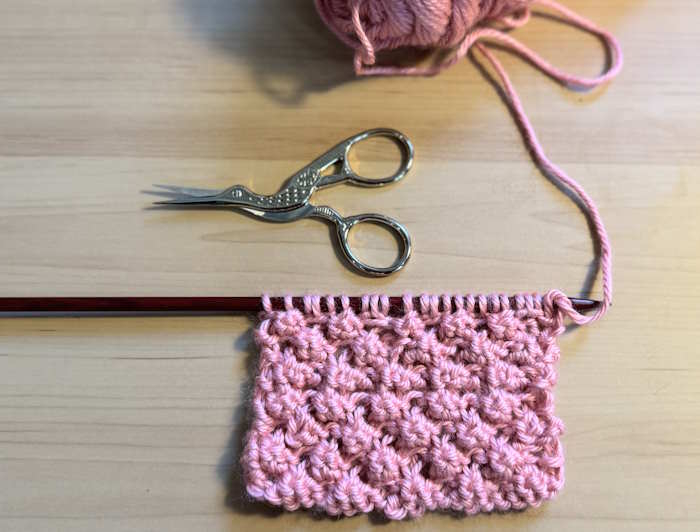
The fabric is textured, dense, and puffy, making it look like a bobble. This stitch might be used alone or in combination with other stitches.
Skill Level

Easy
Abbreviations Used
CO: Cast on
BO: Bind off
K: knit stitch
P: purl stitch
P3tog: Purl 3 stitches together as one stitch
* * Work the instructions between the asterisks, the number of times indicated in the pattern
Skills Needed for the Trinity Stitch
Purl 3 stitches together as one stitch (P3tog)
Make one knit stitch, one purl, and one knit stitch all in the same stitch.
Notes about the Trinity Stitch
- The pattern is worked over a 4-row repeat.
- Stitch multiples of 4.
- The pattern rows are on the wrong side of the project and stick out to the right, which is worked in purl.
- All instructions are written in US terms.
- The Trinity Stitch uses more yarn than other stitches.
- This is a very dense stitch.
Is the Pattern Reversible
This is not a reversible pattern.
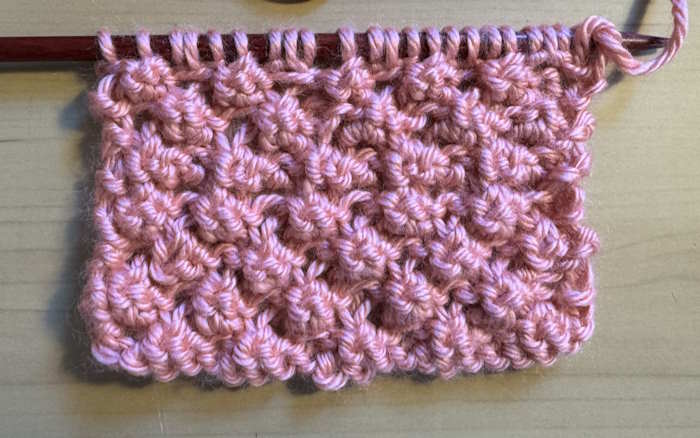 The right side of the Trinity Knit Stitch Pattern
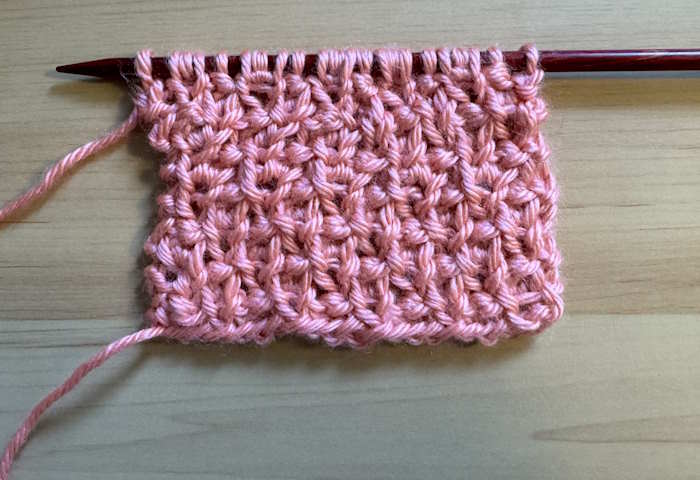 The wrong side of the Trinity Knit Stitch Pattern
Supplies You Will Need for This Tutorial
- Yarn ( I used a 100% Acrylic worsted weight yarn for this swatch)
- Knitting Needles: Size appropriate for the yarn you choose.
- Scissors
- Yarn Needle
Written Directions
How to make the (K1, P1, K1) in the Same Stitch
- To make the K1P1K1, Insert your right needle into the first stitch on the left needle as if to knit.
- Knit the stitch but don’t remove the stitch.
- Bring the yarn to the front and purl the stitch but don’t remove the stitch.
- Bring the yarn to the back, knit the stitch one more time, and then slip the stitch from the needle.
How to Make the Purl 3 Together (P3tog)
This is a triple decrease that is paired with the K1, P1, K1.
- With the yarn held in the front, insert the right hand needle into the next 3 stitches purlwise.
- Purl all three stitches as if it were one stitch and slip from needle.
Trinity Knit Stitch Pattern Directions
CO a multiple of 4 stitches.
Row 1 (right side): Purl across.
Row 2: *(K1, p1, k1) all in the same stitch, purl 3 together. Repeat from * across.
Row 3: Purl across.
Row 4: *P3tog (k1, p1, k1) all in the same stitch. Repeat from * across.
Repeat these four rows until you reach your desired length. Bind off and weave in ends.
Variation of the Trinity Stitch
If you want a simple border, add one purl stitch at the
beginning and end of each row. In this
case, you would cast on multiples of 4 plus 2 and the instructions would look
like this:
CO a multiple of 4 stitches plus 2
Row 1 (right side): Purl.
Row 2: P1, *(K1, p1, k1) all in the same stitch, purl 3 together. Repeat from * across to the last stitch, P1.
Row 3: Purl.
Row 4: P1, *P3tog (k1, p1, k1) all in the same stitch. Repeat from * across to the last stitch, P1.
Repeat these four rows until you reach your desired length. Bind off and weave in ends.
PRO Tips
Please do not get discouraged if this stitch seems difficult to master.
Knitters might find this stitch hard to work with because of the two main techniques used to make it: the triple decrease (Purl 3 Together) and the triple increase.
Here are some tips that I found helped make the stitches easier for me.
- Work on the tips of your needles when making increases and decreases.
- If your stitches are slipping off the tips of the needles, consider a different type of needle, such as a wooden or bamboo needle. These needles hug the stitches and make accidentally losing a stitch more difficult. However, you may also find that steel needles with sharp tips will make it easier for you to work the P3tog.
- Tension is important. If you are a loose knitter, it’s easier to manipulate the stitches. If you are struggling with the stitch, consider going up one needle size.
Projects Using the Trinity/Rasberry Stitch
- Scarves/Cowls – try alternating colors!
- Hats
- Throws
- Wearable items
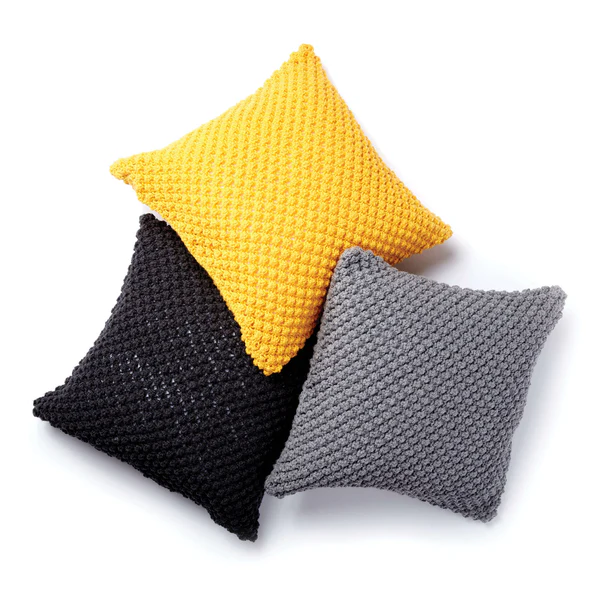
- Home Accessories such as pillows, washcloths, table runners
Free Patterns
Rasberry Cowl
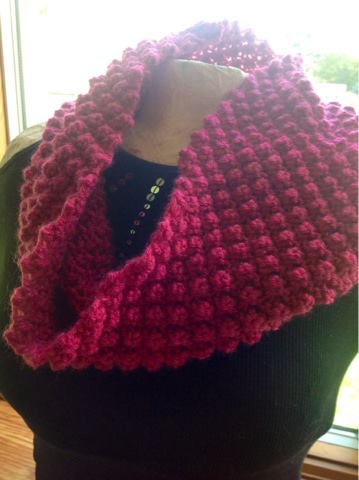
Free Caron Pebble Pop Knit Pillows
Reference
Walker, Barbara, A Treasury of Knitting Patterns. Schoolhouse Press. 2020.
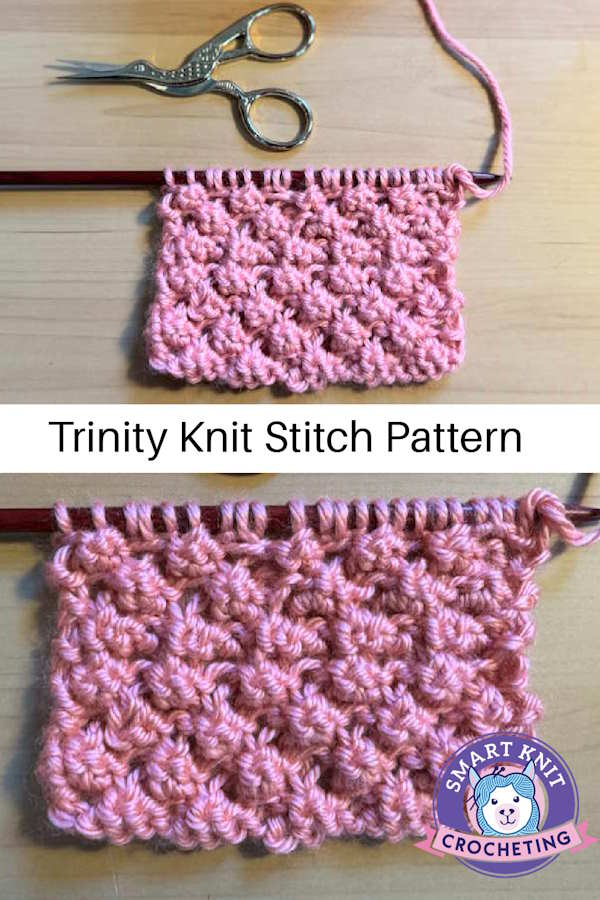
Trinity Knit Stitch Pattern: Pin for Future Reference

Disclosure:
This post contains affiliate links. If you buy through them, I may earn a small commission at no extra cost to you.

Janice Jones is a Certified Knitting and Crochet Instructor who creates beginner-friendly patterns and tutorials, backed by a 389-page library of practical knitting and crochet content.
Most Popular Pages
Comprehensive Guide to Yarn

All Types of Crochet Stitches
36 Reversible Knit Stitch Glossary
How to Crochet the Second Row
Dog Sweater Patterns

Working with Alpaca Yarn
Free eBooks, Just for You
Get my beginner eBook guides to Knitting and Crocheting, just for signing up for my monthly newsletter.
Choose one or both when you sign up.
About the Author: Please allow me to introduce myself

Janice Jones is a Certified Knitting Instructor and Certified Crochet Instructor through the Craft Yarn Council who focuses on beginner-friendly patterns, stitch guides, and technique tutorials. She has built a library of 389 pages on her website, sharing practical instructions and patterns, and has completed projects ranging from crochet blankets to knit sweaters. You can explore her work on her website. She makes items for Warm Up America and often knits and crochets sweaters for her small dogs.
Thank you for visiting Smart-Knit-Crocheting. I hope this and all of my tutorials will give you the inspiration to continue your knit or crochet journey. For a complete list of all the pages on my site, please visit my table of contents.
I participate in the Amazon Services LLC Associates Program, an affiliate advertising program designed to provide a means for sites to earn advertising fees by advertising and linking to Amazon.com. “As an Amazon Associate I earn from qualifying purchases.” These earnings go towards supporting my website.

Home | Contact | About | Privacy Policy | Disclaimer
I DO NOT SELL ANY PERSONAL INFORMATION FROM THIS WEBSITE. PLEASE SEE MY PRIVACY POLICY FOR MORE DETAILS.
Copyright © 2006-2026 Smart Knit Crocheting. All Rights Reserved
Please Share
Remember, Sharing is Caring