- Home
- Filet Crochet
- Free Filet Crochet Patterns Using the Puff Stitch
Filet Crochet Design Technique: How to Use Puff Stitches in Filet Mesh
Rewritten by Janice Jones, Last Updated 01-11-2026
Filet crochet is traditionally known for its open, graphic mesh designs created with double crochet stitches and chain spaces. While classic filet crochet relies on a flat, lace-like structure, it can also be adapted into a richly textured fabric by substituting selected mesh cells with dimensional stitches.
This tutorial shows you how to design textured filet crochet using the puff stitch. Instead of filling a mesh square with solid double crochet stitches, you’ll learn how to replace an open filet cell with a puff stitch worked directly into the mesh framework. The result is a raised, three-dimensional motif that adds depth and visual interest while preserving the recognizable filet structure.
This is not a downloadable pattern collection. Rather, it is a filet crochet design technique that teaches you how to modify traditional filet charts and create your own decorative motifs. Once you understand the method, you can apply it to garments, panels, borders, and your own artistic crochet projects.
If you already know the basics of filet crochet and want to explore more creative, textural possibilities, this technique opens the door to endless variations.
In this tutorial, you’ll learn:
- How traditional filet crochet mesh works
- How to replace open mesh with puff stitches
- When textured filet crochet works best
- How to design your own filet charts
What Is Textured Filet Crochet?
Textured filet crochet is a variation of traditional filet crochet in which selected mesh cells are modified to include raised or dimensional stitches. Instead of working only open spaces and solid blocks, typically using double crochet stitches, texture is introduced by replacing individual mesh squares with decorative elements such as puff stitches, clusters, or other relief stitches.
Classic filet crochet relies on contrast between open and filled spaces to create graphic designs. Textured filet crochet expands on this idea by adding depth, allowing motifs to stand out from the background rather than appearing flat. The underlying grid structure remains the same, but the visual and tactile effect is dramatically different.
This approach is especially useful for artistic crochet, decorative panels, and garments where surface interest is desired without abandoning the recognizable filet framework.
Skill Level and When to Use This Technique
This textured filet crochet technique is best suited for intermediate to advanced crocheters who are already comfortable working traditional filet crochet mesh. You should be familiar with reading filet charts, maintaining even tension, and working double crochet stitches consistently.
This technique works best when:
- You want to add dimension to an otherwise flat filet design
- You are creating decorative panels, borders, or focal motifs
- The project benefits from visual texture rather than light lace
This technique may not be ideal when:
- You need a lightweight or highly drapey fabric
- The design requires strict symmetry on both sides of the fabric
- You are following a traditional filet pattern that depends on flat stitch definition
Because puff stitches add thickness and consume more yarn than standard filet stitches, they are best used selectively rather than across an entire project.
Understanding the Traditional Filet Crochet Mesh
Traditional filet crochet is built on a repeating grid of open and filled cells. Each cell is formed using double crochet stitches and chain spaces, creating a structured mesh that serves as the foundation for charts and pictorial designs.
An open filet mesh cell is typically worked as:
- Double crochet, chain 1, double crochet (dc, ch 1, dc)
- or in some patterns, double crochet, chain 2, double crochet (dc, ch 2, dc)
These mesh cells create consistent spaces that are easy to read on a chart and simple to modify. Because each cell occupies the same footprint, it becomes possible to replace an open mesh with another stitch that fits within it.
In this tutorial, the open mesh cell serves as the anchor point for the puff stitch. By working the puff stitch along the horizontal chain of the mesh, you maintain the grid structure while transforming the fabric's surface.
How Puff Stitches Replace a Filet Mesh Cell
In traditional filet crochet, each open mesh cell occupies a predictable amount of space within the grid. This consistency is what allows filet crochet designs to be charted and modified with precision. When introducing texture, the goal is to replace the mesh cell without disturbing the overall grid structure.
Instead of working a double crochet, chain, double crochet sequence to form an open mesh, a puff stitch is worked directly into the horizontal chain space of the mesh from the previous row. This places the puff stitch in the exact location where an open cell would normally appear.
Because the puff stitch fills the width of a single mesh square, it visually replaces that cell while maintaining alignment with surrounding stitches. The vertical and horizontal rhythm of the filet grid remains intact, keeping the design readable on a chart.
It is important to note that the puff stitch adds height and thickness. For this reason, puff stitches are most effective when used selectively rather than in every mesh cell. Strategic placement preserves the filet structure while drawing attention to specific areas of the design.
In the next section, you’ll see exactly how the puff stitch is worked into the filet mesh, step by step, using photographs to illustrate each stage.
How to Make Puff Stitches in Filet Mesh
In this method, the puff stitch is worked directly into the horizontal chain space of the filet mesh from the previous row. One puff stitch replaces a single open mesh cell.
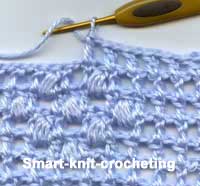
Step 1: Yarn over. Insert your hook under the horizontal chain space of the filet mesh from the previous row and draw up a loop. You should now have 3 loops on the hook.
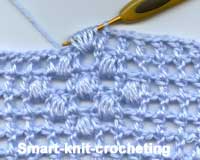
Step 2: Repeat yarn over and draw up a loop three more times, always inserting the hook into the same horizontal chain space. You will now have 9 loops on the hook. Keeping all loops even in height helps the puff stitch remain full and symmetrical.
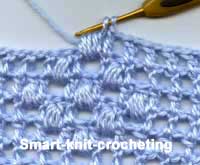
Step 3: Yarn over and pull the yarn through eight loops on the hook. You should now have 2 loops remaining.
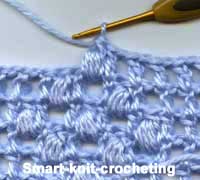
Step 4: Yarn over and pull through the remaining two loops to complete the puff stitch. There is now 1 loop on the hook.
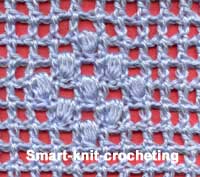

This completed puff stitch replaces one open filet mesh cell. Because it occupies the same position within the grid, it can be repeated, charted, and combined with surrounding mesh stitches without disrupting the overall filet structure.
Using puff stitches for decorating a regular filet crochet mesh, you can design your own patterns. Don't restrict your creativity since the number of variants is endless:
- Change the structure of the filet crochet fabric by spreading puff
stitches here and there.
- Create different geometrical shapes using groups of puff
stitches.
- Decorate the elements of a dress, sweater, or skirt with puff
stitches.
- Combining a few different types of stitches (filet crochet mesh, puff stitches, areas of double crochets, decorative crocheted braids, for example) in the same project brings you a completely new opportunity to design original "crocheted pictures".
Reading and Modifying Filet Crochet Charts
Filet crochet designs are typically represented using charts, where each square corresponds to a mesh cell in the fabric. Open squares represent open mesh stitches, while filled squares represent solid areas. This grid-based system makes filet crochet especially well-suited for modification and creative experimentation.
When introducing puff stitches into a filet crochet chart, each puff stitch simply replaces an open mesh square. The chart itself does not need to change shape or scale; the substitution happens at the stitch level rather than the structural level.
To modify an existing filet crochet chart:
- Identify open mesh cells that would benefit from added texture
- Replace those open cells with puff stitches when crocheting
- Leave surrounding mesh stitches unchanged to preserve contrast
Because puff stitches add dimension and visual weight, they work best when placed intentionally. Highlighting borders, outlining motifs, or filling small focal areas creates a balanced design without overwhelming the filet structure.
If you create your own charts, you can mark puff stitch placements with a simple symbol or notation alongside the traditional filet grid. As long as each puff stitch occupies one mesh square, the chart remains readable and repeatable.
This flexibility allows you to adapt traditional filet crochet designs into textured, contemporary pieces while still using familiar chart-reading techniques.
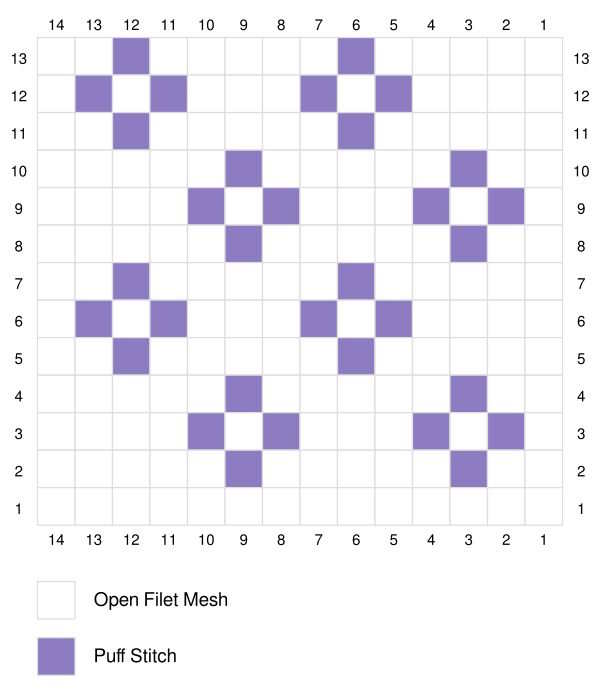 Crochet Charts typically consist of symbols that represent crochet stitches. This is a very simple diagram showing where puff stitches might be placed on an open-mesh background.
Frequently Asked Questions
Is this a free filet crochet pattern or a design technique?
Is this a free filet crochet pattern or a design technique?
This tutorial teaches a filet crochet design technique, not a downloadable pattern. You’ll learn how to replace open mesh cells with puff stitches so you can modify existing filet charts or design your own textured filet crochet motifs.
Can puff stitches be charted in filet crochet?
Can puff stitches be charted in filet crochet?
Yes. Puff stitches can be charted by marking the mesh cell they replace with a symbol, color, or notation. Each puff stitch occupies the same grid space as one open mesh cell, so the overall chart structure remains unchanged.
Do puff stitches change the size of a filet crochet project?
Do puff stitches change the size of a filet crochet project?
Puff stitches add thickness and texture but do not significantly change the width or height of the project when used sparingly. Because they replace existing mesh cells rather than adding stitches, the overall dimensions of the filet design stay consistent.
Is textured filet crochet suitable for beginners?
Is textured filet crochet suitable for beginners?
This technique is best suited for intermediate crocheters who already understand basic filet crochet mesh. Beginners may want to practice traditional filet crochet first before introducing puff stitches into the design.
Conclusion: Designing Textured Filet Crochet With Confidence
Textured filet crochet shows how flexible traditional filet techniques can be when approached from a design perspective. By replacing selected open mesh cells with puff stitches, you can add depth, emphasis, and visual interest without altering the underlying filet structure.
This method allows you to work creatively while still relying on familiar filet crochet charts and stitch placement. Because each puff stitch occupies the same grid space as a standard mesh cell, the technique integrates seamlessly into both existing designs and original motifs.
Whether you use puff stitches sparingly as accents or combine them to form decorative shapes, textured filet crochet encourages thoughtful experimentation. Start with small motifs, test your ideas on swatches, and adjust placement until the
Disclosure:
This post contains affiliate links. If you buy through them, I may earn a small commission at no extra cost to you.

Janice Jones is a Certified Knitting and Crochet Instructor who creates beginner-friendly patterns and tutorials, backed by a 389-page library of practical knitting and crochet content.
Most Popular Pages
Comprehensive Guide to Yarn

All Types of Crochet Stitches
36 Reversible Knit Stitch Glossary
How to Crochet the Second Row
Dog Sweater Patterns
Working with Alpaca Yarn
Free eBooks, Just for You
Get my beginner eBook guides to Knitting and Crocheting, just for signing up for my monthly newsletter.
Choose one or both when you sign up.
About the Author: Please allow me to introduce myself

Janice Jones is a Certified Knitting Instructor and Certified Crochet Instructor through the Craft Yarn Council who focuses on beginner-friendly patterns, stitch guides, and technique tutorials. She has built a library of 389 pages on her website, sharing practical instructions and patterns, and has completed projects ranging from crochet blankets to knit sweaters. You can explore her work on her website. She makes items for Warm Up America and often knits and crochets sweaters for her small dogs.
Thank you for visiting Smart-Knit-Crocheting. I hope this and all of my tutorials will give you the inspiration to continue your knit or crochet journey. For a complete list of all the pages on my site, please visit my table of contents.
I participant in the Amazon Services LLC Associates Program, an affiliate advertising program designed to provide a means for sites to earn advertising fees by advertising and linking to Amazon.com. “As an Amazon Associate I earn from qualifying purchases.” These earnings go towards supporting my website.
Home | Contact | About | Privacy Policy | Disclaimer
I DO NOT SELL ANY PERSONAL INFORMATION FROM THIS WEBSITE. PLEASE SEE MY PRIVACY POLICY FOR MORE DETAILS.
Copyright © 2006-2026 Smart Knit Crocheting. All Rights Reserved
Please Share
Remember, Sharing is Caring