- Home
- How to Crochet (Start Here)
- Reading Crochet Patterns in Chart Form
How to Read Crochet Patterns in Chart Form
Crochet Patterns Updated by Janice Jones December 2025
Crochet patterns are written in two main ways: written instructions and chart diagrams. While many beginners start with written patterns, crochet charts offer a visual way to understand stitch placement, repeats, and pattern structure—without relying on language.
This guide focuses specifically on how to read crochet patterns in chart form, including how to follow rows and rounds, understand crochet symbols, and recognize pattern repeats. Charts are handy for lace, motifs, granny squares, and patterns published in other languages.
If you are new to written instructions, start with my complete beginner's guide on
How to read crochet patterns written in words
Once you understand the basics, learning to read crochet charts will significantly expand the number of patterns you can confidently use.
What Is a Crochet Pattern Chart?
A crochet pattern chart is a visual diagram that shows how stitches are placed and worked, using standardized symbols rather than written instructions. Each symbol represents a specific crochet stitch or action, and the chart shows exactly where those stitches belong in relation to one another.
Unlike written crochet patterns, charts do not rely on language. This makes them especially useful for:
- Patterns published in other countries
- Lace, motifs, and decorative stitches
- Visual learners who prefer diagrams over text
Crochet charts can be worked row by row (back-and-forth) or in the round (such as granny squares and motifs). Once you understand how to follow the symbols and direction, charts can actually be faster and easier to read than written instructions, especially for repeating patterns.
Beginner tip:
If you are new to crochet altogether, start with written instructions first. Once you’re comfortable with basic stitches, charts become much easier to understand and incredibly useful.
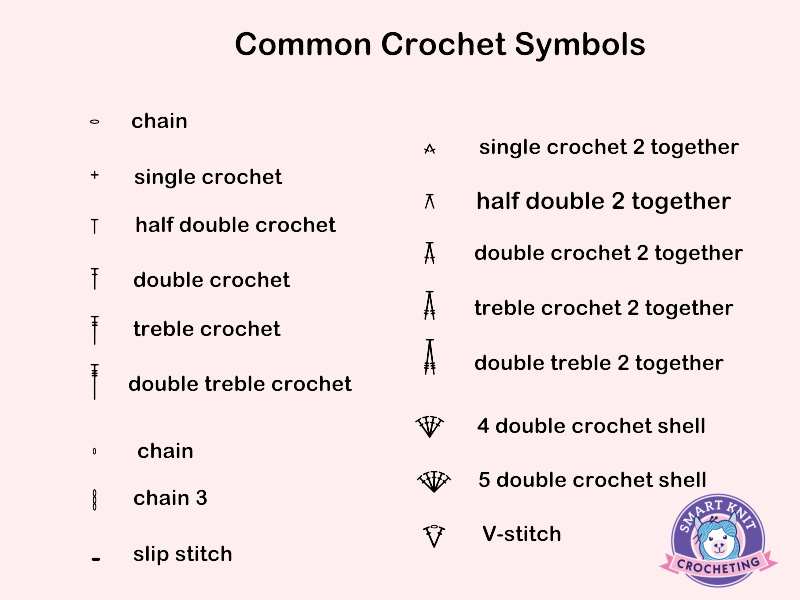
Common Crochet Chart Symbols You Should Know
Crochet charts use a set of internationally recognized symbols, each representing a specific stitch. While the exact appearance of a symbol may vary slightly by designer or the software used to create the chart, the meaning stays the same.
A complete list of common crochet chart symbols can be found at the Craft Yarn Council. Here are a few basic ones that all beginners should know.
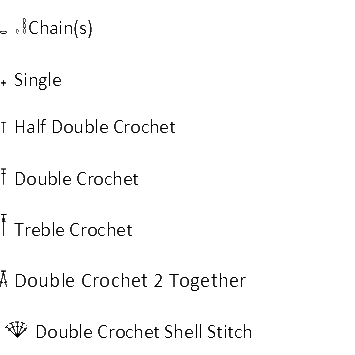
Here are some of the most common symbols beginners will see:
Chain (ch): usually shown as a small oval or circle
Slip stitch (sl st): a filled dot or small symbol
Single crochet (sc): an “X” or plus-shaped symbol
Half double crochet (hdc): a “T” shape with one slash
Double crochet (dc): a tall “T” shape with one slash
Treble crochet (tr): a tall “T” shape with two slashes
Every crochet chart should include a legend or key explaining what each symbol means. Always look for this first; never assume.
Important:
Charts show where stitches go, not just what stitches to make. Pay attention to how symbols stack and connect vertically.
How to Read Crochet Charts Step-by-Step
Reading a crochet chart becomes much easier when you follow a consistent process.
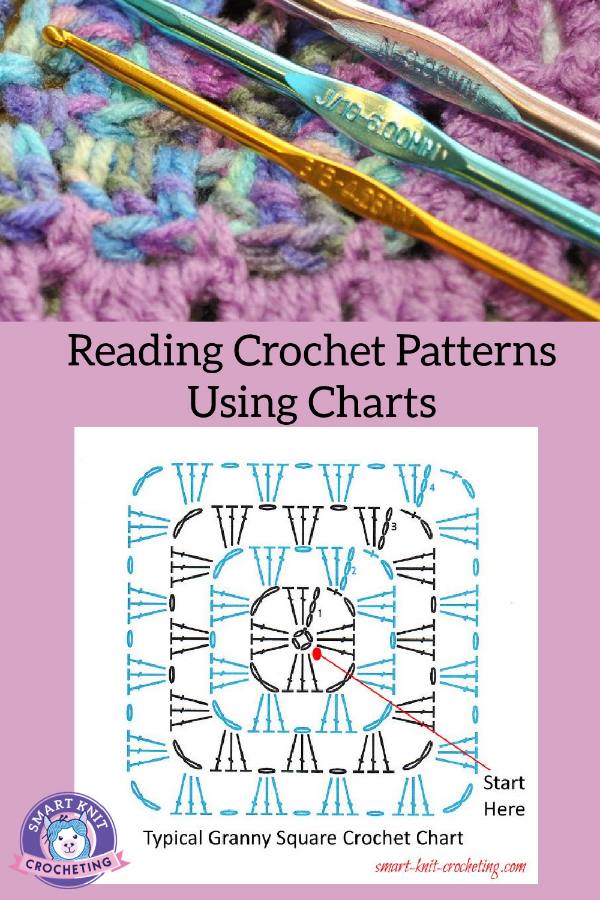
Step 1: Find the Starting Point
- For row-based charts, start at the bottom row
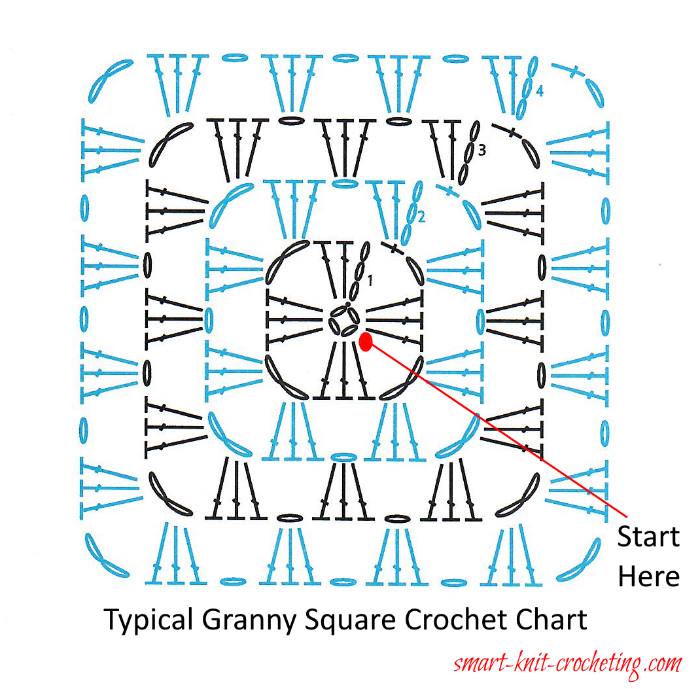
- For in-the-round charts, begin at the center
Starting points are often marked with a dot, arrow, or number.
Step 2: Check the Direction
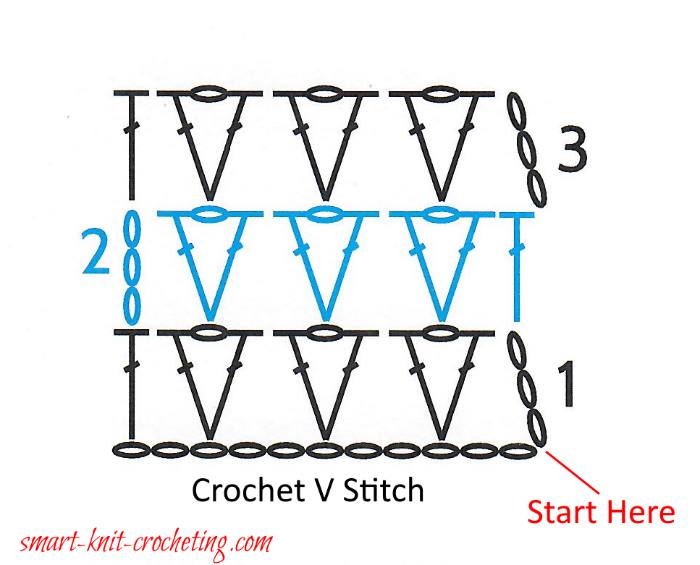
- Rows are usually read: Right to left on odd rows, Left to right on even rows
- Charts worked in the round are read counterclockwise (for right-handed crocheters)
Left-handed crocheters simply reverse the direction.
Step 3: Read the Symbols, Not the Picture
Each symbol tells you what stitch to make and where to place it. Symbols are stacked to show how stitches build on previous rows or rounds.
Step 4: Watch for Repeats
Repeats are often shown with:
Brackets
Shaded sections
Bold outlines
These indicate the section of the chart that repeats across the row or round.
Step 5: Refer to the Legend Often
Even experienced crocheters check the legend. If a stitch looks unfamiliar, pause and confirm before continuing.
Beginner reassurance:
You do not need to memorize symbols. Reading charts is a skill that improves naturally with practice.
H2: Crochet Charts vs Written Patterns: When to Use Each
Both crochet charts and written crochet patterns explain how to make a project, but each format shines in different situations. Knowing when to use each one will make patterns easier to understand and help you choose the format that works best for your project and learning style.
When Crochet Charts Are the Better Choice
Crochet charts are especially helpful when:
- You are working on lace, motifs, or granny squares
- The pattern includes repeats across a wide row
- You want to see the stitch placement visually
- The pattern is written in a foreign language
- You prefer diagrams over long blocks of text
Charts allow you to see how stitches stack and interact, making it easier to catch mistakes and understand pattern structure at a glance.
When Written Crochet Patterns Are the Better Choice
Written patterns are often the better option when:
- You are a beginner learning basic stitches
- The project includes detailed shaping or construction
- You want step-by-step guidance in plain language
- You are working on garments with sizing instructions
- You prefer reading instructions line by line
Written instructions explain what to do next without requiring you to interpret symbols, which many beginners find more reassuring.
Using Both Together (Best of Both Worlds)
Many modern crochet patterns include both written instructions and charts, and this is often the most beginner-friendly option. Written instructions explain what to do, while charts show where stitches go.
If you’re new to reading crochet patterns, start with the written instructions first. Once you’re comfortable with basic stitches, adding charts to your skill set will significantly expand the number of patterns you can confidently follow.
Helpful tip:
If you want a complete beginner's guide focused on written instructions, see my full tutorial on how to read crochet patterns written in words.
There are some general rules to follow while you are reading crochet patterns in charts
- Each stitch in the pattern is represented by its symbol. There are three of them which were used in this chart: chain, single crochet, and double crochet.
- This pattern is written in rows.
- Pattern for crocheting in rows is charted row by row. It starts from the foundation chain. Rows are usually numbered. The very first row is always the bottom one.
- As you work, follow the odd rows from right to left. Follow the even rows from left to right. See the chart. If you are left handed, it is just the opposite.
- Patterns that are worked in the round normally start in the center of the chart.
- Very often a crochet pattern has a section which can be repeated as necessary for width. Repeats are indicated with a brackets below the section which needs to be repeated.
- Stitches in a pattern chart are placed over the stitches in which they have to be worked.
- There should be a key that explains what each symbol stands for.
Keeping in mind these general rules, let's read our pattern.
Work a foundation chain. Length of chain is equal to 50 + 3 (turning chain) chains.
More Complicated Crochet Patterns in Chart Form
Here is a bit more complicated chart, but still one that only uses five basic crochet stitches, chains, slip stitch, single, double and treble crochet stitches.
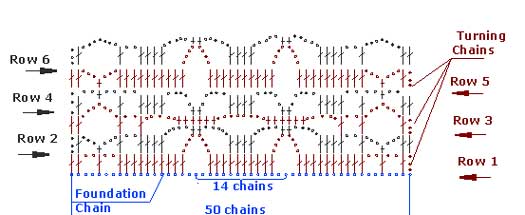
Here's the Same Directions, Written Out in Words
Row 1: Make 1 double crochet into the fourth chain from the hook, 2 chains, skip 2 chains,1 double crochet, 2 chains, 10 double crochets, 8 chains, 10 double crochets. Follow the pattern to the end of the row. Finish with 2 double crochets.
Row 2: 3 turning chains, 1 double crochet, 3 chains, 1 single crochet into 1 double crochet of the first row, 3 chains, 1 double crochet, 2 chains, 4 double crochets into 4,5,6,and 7 double crochets of the first row, 5 chains, 2 single crochets into 4 and 5 chains of the 1 st row, 5 chains. Follow the pattern to the end of the row. Finish with 2 double crochets.
Row 3: 3 turning chains, 1 double crochet, 7 chains, 1 double crochet into 1 double crochet, 2 chains, 1 double crochet, 5 chains, 6 single crochets into the 4, 5 chains, 2 single crochets, 1,2 chains of the 2 row, 8 chains. Finish with 2 double crochets.
Row 4: 3 turning chains, 1 double crochet, 2 chains, 1 single crochet into 1 single crochet, 2 chains, 1 double crochet, 2 chains, 4 double crochets into 1,2,3 chains, 5 chains, 2 single crochets into 3 and 4 single crochets, 5 chains. Follow the pattern to the end of the row. Finish with 2 double crochets.
Row 5: 3 turning chains, 1 double crochet, 3 chains, 1 single crochet into 1 single crochet, 3 chains, 10 double crochet, 8 chains, 10 double crochets. Follow the pattern to the end of the row. Finish with 2 double crochets.
Row 6: 3 turning chains, 1 double crochet, 8 chains, 1 double crochet into 1st double crochet, 2 chains, 4 double crochet into 4,5,6,7 double crochets, 5 chains, 2 single crochet into 4 and 5 chains, 5 chains. Follow the pattern to the end of the row. Finish with 2 double crochets.
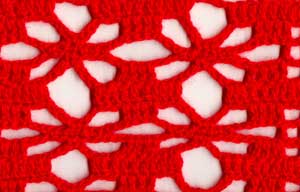
Here is how our crochet pattern looks like.
Now you have the idea about the rules crochet patterns can be described in charts.
It will help you to save time while you are working on your projects. It doesn't really matter whether you are going to use written instructions or charts. The most important is your enjoyment from what you are doing.
You do not necessarily need to have complicated patterns to make your project. In most cases a real masterpiece is made with simple techniques, good taste, and basic crochet pattern.
Common Mistakes Beginners Make When Reading Crochet Charts
Learning to read crochet charts takes practice, and it’s normal to feel confused at first. Most mistakes happen because charts are visual rather than written. Knowing what to watch for can save time and frustration.
Ignoring the Chart Legend or Key
Every crochet chart includes a legend that explains the meaning of each symbol. Beginners often skip this step and assume the symbols are universal. While most symbols follow international standards, designers may vary slightly in their implementation. Always check the legend before starting.
Reading the Chart in the Wrong Direction
Crochet charts must be read in a specific direction:
Row-based charts:
Odd rows are read right to left, even rows left to right (for right-handed crocheters)
Charts worked in the round:
Read from the center outward, usually counterclockwise
Reading in the wrong direction can completely change the pattern.
Focusing on the Picture Instead of the Symbols
It’s tempting to treat a crochet chart like an image, but charts are instructions, not illustrations. Each symbol represents a specific stitch and placement.
Train your eye to follow symbol by symbol, not shape by shape.
Forgetting Turning Chains or Starting Chains
Turning chains and starting chains are often shown on charts, but can be easy to overlook. These chains count as stitches in many patterns and affect the height and alignment of the piece.
Always check whether turning chains count as a stitch in the chart.
Frequently Asked Questions About Crochet Chart Patterns
Are crochet charts the same as written crochet patterns?
Are crochet charts the same as written crochet patterns?
No. Crochet charts use symbols and diagrams to show stitch placement visually, while written patterns explain each step using words and abbreviations. Both formats describe the same information, just in different ways.
Are crochet charts beginner-friendly?
Are crochet charts beginner-friendly?
Crochet charts can be beginner-friendly once you know basic stitches, but many beginners find written patterns easier at first. Charts become much easier to understand after you learn how symbols work and how rows or rounds are read.
Do crochet charts work the same for everyone?
Do crochet charts work the same for everyone?
Yes. Crochet charts use international symbols, so they work the same regardless of language or country. This makes charts especially useful for patterns published outside your native language.
Crochet Patterns Written in Chart Form
Pin for Future Reference

Disclosure:
This post contains affiliate links. If you buy through them, I may earn a small commission at no extra cost to you.
Janice Jones is a Certified Knitting and Crochet Instructor who creates beginner-friendly patterns and tutorials, backed by a 389-page library of practical knitting and crochet content.
Most Popular Pages
Comprehensive Guide to Yarn

All Types of Crochet Stitches
36 Reversible Knit Stitch Glossary
How to Crochet the Second Row
Dog Sweater Patterns
Working with Alpaca Yarn
Free eBooks, Just for You
Get my beginner eBook guides to Knitting and Crocheting, just for signing up for my monthly newsletter.
Choose one or both when you sign up.
About the Author: Please allow me to introduce myself
Janice Jones is a Certified Knitting Instructor and Certified Crochet Instructor through the Craft Yarn Council who focuses on beginner-friendly patterns, stitch guides, and technique tutorials. She has built a library of 389 pages on her website, sharing practical instructions and patterns, and has completed projects ranging from crochet blankets to knit sweaters. You can explore her work on her website. She makes items for Warm Up America and often knits and crochets sweaters for her small dogs.
Thank you for visiting Smart-Knit-Crocheting. I hope this and all of my tutorials will give you the inspiration to continue your knit or crochet journey. For a complete list of all the pages on my site, please visit my table of contents.
I participate in the Amazon Services LLC Associates Program, an affiliate advertising program designed to provide a means for sites to earn advertising fees by advertising and linking to Amazon.com. “As an Amazon Associate I earn from qualifying purchases.” These earnings go towards supporting my website.
Home | Contact | About | Privacy Policy | Disclaimer
I DO NOT SELL ANY PERSONAL INFORMATION FROM THIS WEBSITE. PLEASE SEE MY PRIVACY POLICY FOR MORE DETAILS.
Copyright © 2006-2026 Smart Knit Crocheting. All Rights Reserved
Please Share
Remember, Sharing is Caring