- Home
- Types of Crochet Stitches
- Crochet Shell Stitches
Crochet Shell Stitches
Crochet Shell Stitches by Janice Jones
The crochet shell stitch is a lovely beginner stitch that can be used as a stand-alone stitch for blankets, pillows, scarves or any number of handmade goodies. There are other names for the shell stitch. There are other names for the shell stitch—you might also hear it called the fan stitch or scallop stitch.
It adds texture but it is also a great choice for a decorative border. You’ll see it used in patterns created with one color, two colors, or any number of color changes for a distinctive look. The crochet shell stitch also makes a lovely border on knitted items.
Table of Contents
- What Is a Crochet Shell Stitch?
- Why Use Shell Stitches?
- Skills Needed to Crochet a Shell Stitch
- Crochet Shell Stitch Swatch Tutorial
- Using Multiple Colors in Shell Stitches
- Shell Stitch as a Decorative Border
- More Creative Shell Stitch Ideas
- Hints for Success with Shell Stitches
- FAQs About Crochet Shell Stitches
- Meet the Author
What Is a Crochet Shell Stitch?
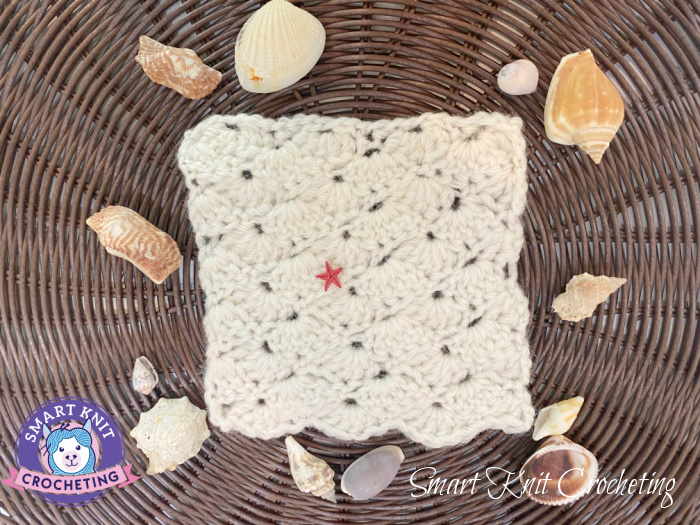
The shell stitch is a type of cluster stitch that is formed when three or more stitches such as double crochets are worked into the same chain, stitch or space.
They are often worked with an uneven number of stitches so there is a center stitch that creates the stitch. They resemble a seashell or fan when completed. Shells can be used as a stand-alone stitch or employed as a border on both knit and crochet fabrics.
Why Use Shell Stitches?
Shell stitches are a versitile and easy pattern to learn for beginners and create an interesting, textured fabric that can be used for a wide variety of projects:
- Dishcloths and Table Runners
- Pillow covers
- Blankets
- Scarves
- Baby items
- Crochet wearables such as hats, cowls, sweaters, tops, and many other items
Skills Needed to Crochet a Shell Stitch
How to make the double crochet stitch
How to make the single crochet stitch
How to fasten off and weave in ends
Crochet Shell Stitch Swatch Tutorial
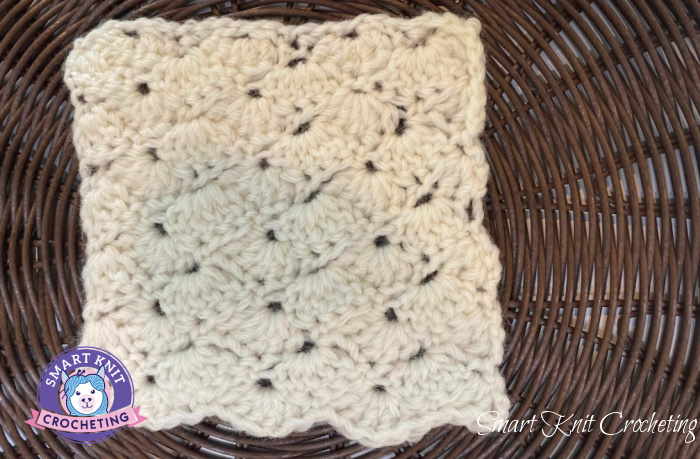
Chain 25 (a multiple of 6, plus 1—for this pattern, 6 × 4 = 24, plus 1 = 25)
Row One:
- Work 2 double crochet stitches in the fourth chain from the hook.
- Skip 2 chain stitches, then make 1 single crochet in the next chain stitch.
- Skip 2 more chain stitches.
- Make five double crochet stitches in the next chain. (These five double crochet stitches will make one shell).
- Next, skip 2 chains and make 1 single crochet in the next chain stitch.
- Skip 2 more chain stitches.
- Make five double crochet stitches in the next chain.
- Continue across the row. Turn.
Row Two:
- Make 3 chain stitches (counts as one double crochet).
- Work two more double crochet stitches into the first stitch. You should now have 3 double crochet stitches at the beginning of the row.
- Skip the next two stitches and work a single crochet stitch into the center of the group of five double crochet stitches making up the shell.
- Skip the next two stitches. Work a group of five double crochets (another shell) into the single crochet from the previous row.
- Repeat these steps until you reach the end of the row. Work three double crochet stitches into the last single crochet, forming another half shell. Then make 1 single crochet in the top chain. Turn.
Row Three:
- Chain one for the turning chain.
- Work a single crochet stitch into the first stitch.
- Skip the next two stitches.
- Work a group of five double crochet stitches into the next stitch.
- Skip the next two stitches.
- Work a single crochet stitch into the middle of the next shell.
- Continue this pattern to the end of the row, finishing with a single crochet into the turning chain.
Repeat Rows Two and Three for the crochet shell stitch pattern.
Using Multiple Colors in Shell Stitches
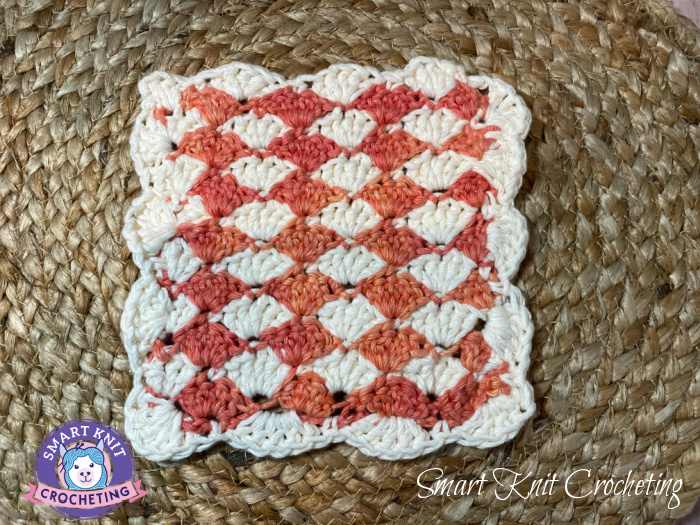
The Crochet Shell Stitch is especially lovely when done in two or more colors and adding different rows of color can be quite easy. In the sample below, I used two colors in a 100% cotton yarn to make a small washcloth or dishcloth. I changed colors every other row. I finished it off by adding a shell border to 3 sides which is also easy to do. I will discuss this in the section below.
You can carry the colors down the side of the piece or finish off each row and then weave in the ends. Here's a short tutorial on changing colors in crochet.
Shell Stitch as a Decorative Border
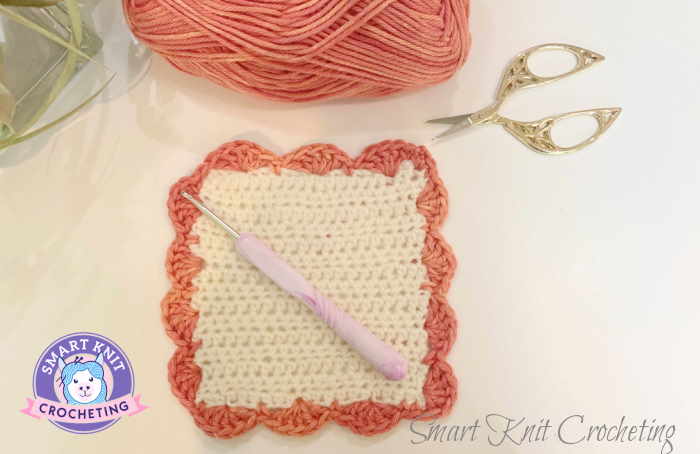
You can also use the shell stitch to create a beautiful border. To do this:
- Attach border yarn with a slip knot
- Begin with a base row of single crochet around your project.
- Skip two stitches and then make 5 dc in the same stitch.
- Skip two stitches, then work a sc in the next stitch.
- Continue this pattern until you reach the corner.
- Adjust the stitch count by adding or subtracting a single crochet.
- When the border is complete, fasten off and weave in ends.
More Creative Shell Stitch Ideas
- Your project can be a crochet fabric or a knit fabric.
- Even more creative is adding a crochet shell stitch border sewn to a handmade item or a ready-made project that adds extra texture and a handmade touch.
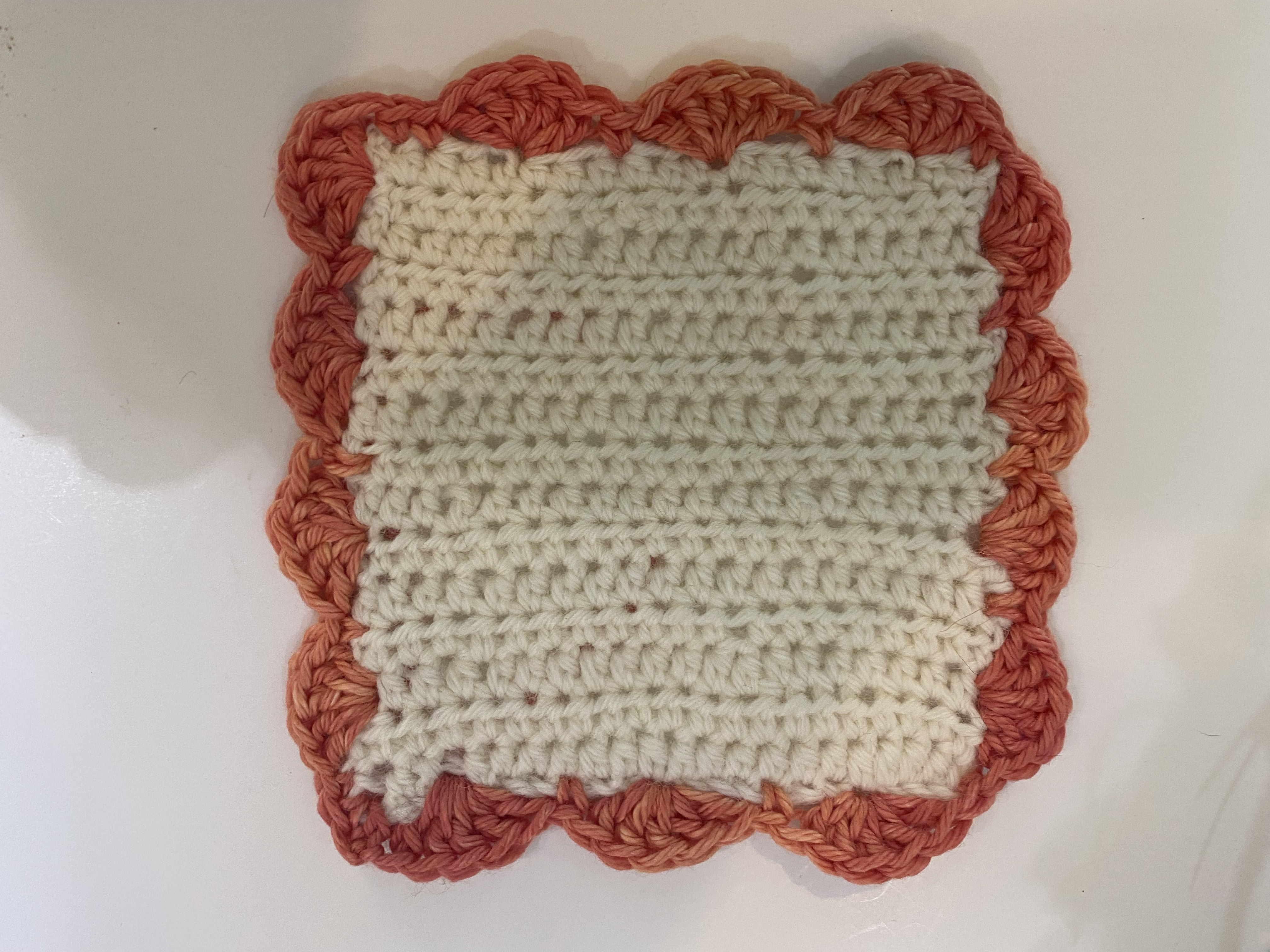 This swatch is created with half-double crochet stitches, adding a shell stitch border.
Hints for Success with Shell Stitches
Always Count Your Stitches
Shell stitch patterns often require skipping stitches, which makes it surprisingly easy to lose or gain one without realizing it. Be sure to:
Pro Tip: In longer rows, stop halfway through and count. It saves you the frustration of having to frog the whole row! (Ask me how I know!)
- Count your stitches at the end of every row.
- Use stitch markers to mark the start of each shell if you’re just getting started.
Watch Your Turning Chains
The turning chain is crucial for keeping your edges straight. Depending on the pattern:
- Use a ch-3 as a stand-in for a double crochet at the beginning of a row. If you find that your sides are looking a little wonky with 3 chains, try making 2 chains and see how it looks.
- Make sure you work into the top of the turning chain at the end of the row when needed—this prevents edge gaps.
Keep Your Tension Consistent
I probably mention tension on every project. Why? Good tension will create professional results, but it takes time and practice. Shell stitches group multiple stitches into one space, so if some of those stitches are big or loose and others tight, it can cause:
- Bunched or wavy fabric
- Crooked rows
Try to:
- Practice a few swatches to get a feel for shell stitch flow.
- Relax your hands—tight stitches make shells harder to see.
- Tension will improve over time so if this is one of your first projects, please do not expect perfection.
Don’t Skip the Foundation Row When Adding a Shell Stitch Border
Before adding a shell border to a project, always start with a base round of single crochet:
- It evens out your edge.
- It gives your shells something solid to grip into.
- It prevents pulling or rippling at the edges.
Use Stitch Markers
When I was first learning shell stitches, I kept trying to ‘eyeball’ where to insert my hook for each new shell. I guess I was just too lazy to use stitch markers. But now I know that stitch markers are your friends. Mark your stitches, follow the count, and your pattern will flow beautifully. Shell stitches are all about rhythm.
FAQs About Crochet Shell Stitches
FAQs About Crochet Shell Stitches
What is the difference between a shell stitch and a fan stitch?
The terms “shell stitch” and “fan stitch” are often used interchangeably. Both involve creating multiple stitches (usually double crochets) into the same space to form a fan- or shell-like shape. The difference usually comes down to spacing and personal or regional terminology.
Are shell stitches good for beginners?
Yes! Shell stitches are perfect for beginners who already know how to chain, single crochet, and double crochet. They’re a great way to practice stitch counting and tension while creating something beautiful.
What can I make with the shell stitch?
Shell stitches are great for blankets, baby items, dishcloths, scarves, and especially for borders on both crochet and knit projects.
Why are my shell stitches uneven?
Uneven shell stitches are usually caused by inconsistent tension, skipping or adding stitches, or placing stitches in the wrong location. Keep your stitch count consistent and your tension relaxed.
Can I use shell stitch as a border?
Yes! Shell stitch makes a beautiful edging. Start with a base round of single crochet around your project, then work the shell stitch into that round to ensure a neat, even border.
Crochet Shell Stitch: Pin for Future Reference

References
The Crochet Answer Book by Edie Eckman (Available on Amazon)
The Complete Photo Guide to Crochet by Margaret Hubert (Available on Amazon)
Disclosure:
This post contains affiliate links. If you buy through them, I may earn a small commission at no extra cost to you.

Janice Jones is a Certified Knitting and Crochet Instructor who creates beginner-friendly patterns and tutorials, backed by a 389-page library of practical knitting and crochet content.
Most Popular Pages
Comprehensive Guide to Yarn

All Types of Crochet Stitches
36 Reversible Knit Stitch Glossary
How to Crochet the Second Row
Dog Sweater Patterns

Working with Alpaca Yarn
Free eBooks, Just for You
Get my beginner eBook guides to Knitting and Crocheting, just for signing up for my monthly newsletter.
Choose one or both when you sign up.
About the Author: Please allow me to introduce myself
Janice Jones is a Certified Knitting Instructor and Certified Crochet Instructor through the Craft Yarn Council who focuses on beginner-friendly patterns, stitch guides, and technique tutorials. She has built a library of 389 pages on her website, sharing practical instructions and patterns, and has completed projects ranging from crochet blankets to knit sweaters. You can explore her work on her website. She makes items for Warm Up America and often knits and crochets sweaters for her small dogs.
Thank you for visiting Smart-Knit-Crocheting. I hope this and all of my tutorials will give you the inspiration to continue your knit or crochet journey. For a complete list of all the pages on my site, please visit my table of contents.
I participate in the Amazon Services LLC Associates Program, an affiliate advertising program designed to provide a means for sites to earn advertising fees by advertising and linking to Amazon.com. “As an Amazon Associate I earn from qualifying purchases.” These earnings go towards supporting my website.
Home | Contact | About | Privacy Policy | Disclaimer
I DO NOT SELL ANY PERSONAL INFORMATION FROM THIS WEBSITE. PLEASE SEE MY PRIVACY POLICY FOR MORE DETAILS.
Copyright © 2006-2026 Smart Knit Crocheting. All Rights Reserved
Please Share
Remember, Sharing is Caring