- Home
- Knit and Purl Stitches
- Pique Triangle Stitch
How to Knit the Pique Triangle Stitch
by Janice Jones, Certified Knitting Instructor (CYC), Published March 12, 2026
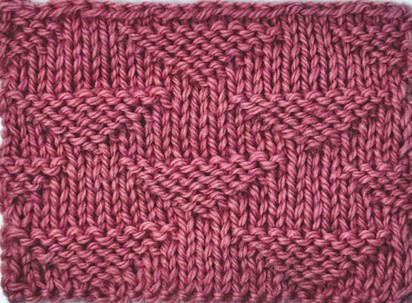
The Pique Triangle knit stitch creates an interesting fabric that resembles a series of small inverted isosceles triangles evenly spaced across the fabric's width. Although it looks impressive, it only uses knit and purl stitches, so it is approachable for adventurous beginners. It is worked over a 12-row repeat, and a multiple of 12 stitches.
It is also reversible because the right and wrong sides of the fabric are mirror images of each other, making it ideal for any project where the front and back will show.
Pattern Notes At a Glance
- Skill level: Easy
- Stitch multiple: 12
- Row repeat: 12
- Reversible: Yes
- Worked flat: Yes
- Worked in the round: Yes
- Fabric behavior: Lies flat
- Techniques used: Knit and purl only
Why You’ll Love This Stitch
The Pique Triangle Stitch is a great choice when you want a pattern that looks textured and interesting without being hard to knit. It uses only knit and purl stitches, but the repeating triangles make the fabric look much more advanced than it really is. Because it is reversible and lies flat, it works especially well for scarves, blankets, and other projects where both sides may show. This is a fun stitch for confident beginners who are ready to move beyond the basics.
Skills Needed
How to cast on using the long-tail cast-on method
How to read a written knitting pattern
How to work from a knitting chart
Supplies for a Practice Swatch
To practice the Pique Triangle Stitch, you should gather:
- Yarn (solid color shows the stitch definition best) in a #3, 4, or 5 weight yarn
- Needles sized to match your yarn, such as US 6 (4.0 mm), US 7 (4.5 mm), US 8 (5.0 mm), or US 9 (5.5 mm)
- Scissors
- Tapestry Needle
- Stitch markers (optional, for marking pattern repeats)
Abbreviations
k - knit
p - purl
RS - right side
WS - wrong side
rep - repeat
* * - Work the instructions contained in the two asterisks the total of times indicated.
Written Instructions for Working Flat
Cast on a multiple of 12 stitches. For a practice swatch, I recommend casting on 24 sts.
Row 1 (RS): * K6, P1,
K5; rep from * to end of row.
Row 2 (WS): *P4, K3, P5; rep from * to end of row.
Row 3: *K4, P5, K3; rep from * to end of
row.
Row 4: *P2, K7, P3; rep from * to end of
row.
Row 5: *K2, P9, K1; rep from * to end of
row.
Row 6: Purl across row.
Row 7: *P1, K11; rep from * to end of row.
Row 8: *K1, P9, K2; rep from * to end of
row.
Row 9: *P3, K7, P2; rep from * to end of row.
Row 10: *K3, P5, K4; rep from * to end of row.
Row 11: *P5, K3, P4; rep from * to end of row.
Row 12: Purl across row
Repeat rows 1 – 12 for the pattern.
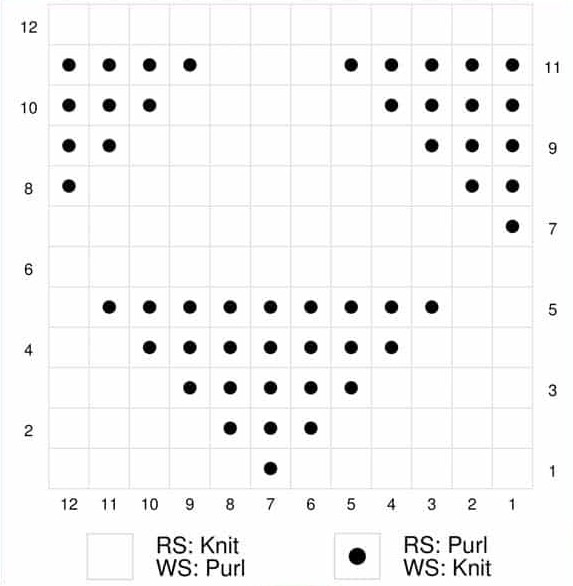
Chart Instructions for Working Flat
Written Instructions for Working in the Round
Cast On in Multiples of 12.
Round 1:
*K6, P1, K5; rep from * around.
Round 2: *K5, P3, K4; rep from * around.
Round 3: *K4, P5, K3; rep from * around.
Round 4: *K3, P7, K2; rep from * around.
Round 5: *K2, P9, K1; rep from * around.
Round 6: Knit all stitches around.
Round 7: *P1, K11; rep from * around.
Round 8: *P2, K9, P1; rep from * around.
Round 9: *P3, K7, P2; rep from * around.
Round 10: *P4, K5, P3; rep from * around.
Round 11: *P5, K3, P4; rep from * around.
Round 12: Knit all stitches around.
Repeat rounds 1 through 12 for the pattern.
Troubleshooting and Beginner Tips
Why don’t my triangles stand out clearly?
This usually happens when the yarn is too dark, fuzzy, or colorful. For the best stitch definition, use a smooth yarn in a lighter solid color.
Why does my pattern look uneven?
Check your tension and make sure you are counting correctly within each 12-stitch repeat. Stitch markers can help you keep track of repeats across the row.
I keep losing my place. What should I do?
Because this stitch is worked over 12 rows, it helps to use a row counter or mark off each completed row on a printed copy of the pattern.
Why does my fabric not look reversible?
The two sides should mirror each other, but they will not look exactly identical at first if your tension differs between knit and purl rows. After a few repeats and blocking, the fabric usually looks more balanced.
Best Yarns for the Pique Triangle Stitch
To distinguish the triangles, a solid-color yarn in a lighter shade is needed. When dark colors are used, it is very difficult to see the triangles. Variegated, heavily heathered, fuzzy, or novelty yarns can hide the stitch definition and make the triangle pattern harder to see.
Learn more about all types of yarns in my Comprehensive Guide to Yarn
Project Ideas
This is a versatile stitch pattern that can be used for many different projects.
- Dishcloths and Washcloths
- Placemats and table runners
- Coaster sets
- Pillow covers
- Blankets of all sizes
- Scarves and cowls
- Shawls
- Panels on sweaters and vests
Click to be taken to a Comprehensive List of Stitch patterns that are Reversible
Frequently Asked Questions about the Pique Triangle Stitch
Is the pique triangle stitch good for beginners?
Is the pique triangle stitch good for beginners?
Yes. The pique triangle stitch is a good choice for beginners who are comfortable with the basic knit and purl stitches. The pattern usually relies on simple combinations of knits and purls to create the triangular texture. Once you complete one or two repeats, the rhythm of the pattern becomes easy to follow.
Does the pique triangle stitch curl?
Does the pique triangle stitch curl?
Most versions of the pique triangle, including the one presented on this page, lie fairly flat because the pattern includes both knit and purl stitches. However, like many textured stitches, a small amount of edge curl can occur if the fabric is worked without a border. If you plan to use this stitch for a scarf or blanket, consider adding a few rows of garter stitch or seed stitch on the edges.
What types of yarn work best with the pique triangle stitch?
What types of yarn work best with the pique triangle stitch?
Smooth yarns usually show the triangular texture best. Wool, wool blends, and smooth acrylic yarns allow the stitch pattern to stand out clearly. Highly textured, fuzzy, or heavily variegated yarns can obscure stitch definition and make the triangles harder to see.
Is the pique triangle stitch reversible?
Is the pique triangle stitch reversible?
Yes. The pique triangle stitch is reversible because both sides are attractive and show the triangle motif in opposite relief. One side highlights the triangles in stockinette, while the other shows them in reverse stockinette, making this a good choice for projects where both sides may be visible.
What projects work well with the pique triangle stitch?
What projects work well with the pique triangle stitch?
This textured stitch works well in projects where the fabric can really show off the raised pattern. Some good options include:
- Dishcloths and washcloths
- Textured scarves
- Blankets and afghans
- Pillow covers
- Sweaters or cardigans with textured panels
The stitch adds visual interest without being overly complicated, making it suitable for both small practice projects and larger pieces.
Can I knit the pique triangle stitch in the round?
Can I knit the pique triangle stitch in the round?
Yes, but the instructions will need to be adjusted. Please see the instructions on this page. Many stitch patterns are written assuming flat knitting with right-side and wrong-side rows. When knitting in the round, every round is worked from the right side, so purl rows may need to be converted to knit stitches (or vice versa). Once adjusted, the stitch pattern can work beautifully in hats, cowls, and sweaters.
Conclusion
The pique triangle stitch is a wonderful example of how simple knit and purl combinations can create beautiful, textured fabric. The repeating triangular pattern adds visual interest without requiring complicated techniques, making it an enjoyable stitch for knitters ready to move beyond beginner patterns.
Whether you use it for a cozy dishcloth, a textured scarf, or part of a larger blanket, this stitch offers a satisfying rhythm that becomes easier with each repeat. With the right yarn and a little practice, the pique triangle stitch can add depth and personality to many knitting projects.
Disclosure:
This post contains affiliate links. If you buy through them, I may earn a small commission at no extra cost to you.

Janice Jones is a Certified Knitting and Crochet Instructor who creates beginner-friendly patterns and tutorials, backed by a 389-page library of practical knitting and crochet content.
Most Popular Pages
Comprehensive Guide to Yarn

All Types of Crochet Stitches
36 Reversible Knit Stitch Glossary
How to Crochet the Second Row
Dog Sweater Patterns
Working with Alpaca Yarn
Free eBooks, Just for You
Get my beginner eBook guides to Knitting and Crocheting, just for signing up for my monthly newsletter.
Choose one or both when you sign up.
About the Author: Please allow me to introduce myself

Janice Jones is a Certified Knitting Instructor and Certified Crochet Instructor through the Craft Yarn Council who focuses on beginner-friendly patterns, stitch guides, and technique tutorials. She has built a library of 389 pages on her website, sharing practical instructions and patterns, and has completed projects ranging from crochet blankets to knit sweaters. You can explore her work on her website. She makes items for Warm Up America and often knits and crochets sweaters for her small dogs.
Thank you for visiting Smart-Knit-Crocheting. I hope this and all of my tutorials will give you the inspiration to continue your knit or crochet journey. For a complete list of all the pages on my site, please visit my table of contents.
I participate in the Amazon Services LLC Associates Program, an affiliate advertising program designed to provide a means for sites to earn advertising fees by advertising and linking to Amazon.com. “As an Amazon Associate I earn from qualifying purchases.” These earnings go towards supporting my website.

Home | Contact | About | Privacy Policy | Disclaimer
I DO NOT SELL ANY PERSONAL INFORMATION FROM THIS WEBSITE. PLEASE SEE MY PRIVACY POLICY FOR MORE DETAILS.
Copyright © 2006-2026 Smart Knit Crocheting. All Rights Reserved
Please Share
Remember, Sharing is Caring